

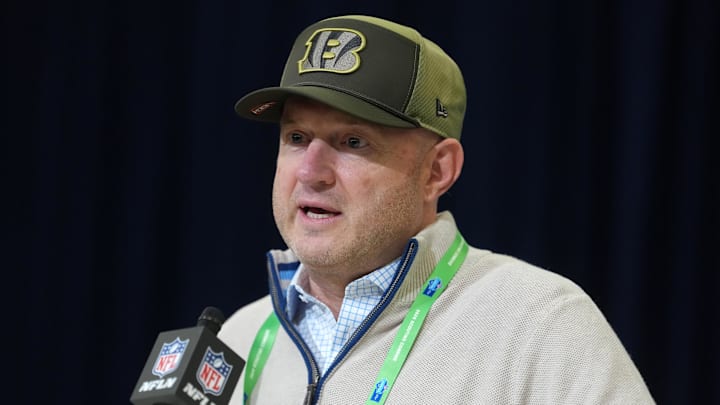
After the Cincinnati Bengals make fair selections at the upcoming NFL draft, they will have lots of things to say about why they selected the player.
However, there are tried-and-true phrases that are alarming and should be seized upon when we hear them from the coaching staff and personnel departments as they discuss players selected from the college ranks.
Here are six tropes that we should not want to hear from the coaching staff during their post-draft press conferences.
1. “X player was productive two years ago”
One of the phrases that we sometimes hear from teams is that their selected player produced at a high clip two seasons ago. But they did not flash this year because of unforeseen circumstances.
“When you look at the film from two seasons ago… We think we can get him back to that.“
Those circumstances could include, but not be limited to, changing schools, systems, head coaches, etc.
Meanwhile, in other players’ circumstances, other teams will be talking about the players they selected who improved once their situations changed, whatever they may be.
Furthermore, it is better to take a chance on a player who is ascending rather than one who has perhaps taken a step back. Especially considering that the prospects’ situation is about to change yet again.
Taking a player who produced two years ago might not fit the bill. The obvious exceptions to that particular rule are a global pandemic and injury.
2. “X was a five-star recruit coming out of high school, five years ago”
Was Al Bundy a five-star recruit out of high school? The way he told his stories had us believing that was the case anyway.
When the inevitable question about what the scouts or coaches saw in a draft pick comes, and the answer is that the player was a five-star recruit five or six years ago, cut the mic.
If the player was a five-star recruit out of high school just three years ago but has little to no production on the field, we may need James Rapien to bum-rush the stage.
That is good information and highly relevant to his background, but it should not be a box to check when selecting a player.
If we should be wary of players who had less-than-stellar final seasons preceded by very good ones, we should be even more vigilant about those who did not perform up to expectations after being heralded as five-star recruits out of high school.
A prospect being a five-star recruit is akin to the Bengals choosing potential over production, as they have done so many times, much to the chagrin of the fan base, given the team's overall performance of late.
As Indiana head coach Curt Cignetti preaches, the Bengals must get players who have proven production rather than bank on amorphous, unrealized potential.
That will go a long way to helping the Bengals in 2026, rather than banking on whatever potential gains come from a former five-star recruit coming out of high school, they forecast for 2027 and beyond.
3. “X wouldn't be here if it weren't for Y”
One of the precursors to discussing a player positively is saying that the player wouldn't be available if it weren't for a certain set of peculiar circumstances.
We have all heard those types of comments, especially the one that sounds like, “if he had entered the draft last season, he would have been a top 10 pick, but since he came out this year, he fell to us at number 28.”
This series of unfortunate events is exactly what happened in 2015 when the Bengals selected Cedric Ogbuehi in the first round. Horrendous game film did not prevent offensive line coach Paul Alexander from saying, “No chance we get this guy if he doesn’t get hurt.”
Perhaps the biggest reason this happens is the drop-off from the penultimate season to the final one. Stating that a player would not be available for whatever reason goes back to the idea of playing better two years ago than last season.
The 2026 draft is not the 2025 one. Nor is it the same as what we will witness in 2027. The NFL draft is a river that teams and players cannot step into twice, as the French would say.
If teams really do go through every scenario before the draft, pointing out how well prepared they are for every contingency to their fan base, the number of times we hear that we never expected an ex-player to be there when we were on the clock should be a lot less than what plays out over the entirety of the draft weekend.
4. “We expect him to develop for us”
The Bengals went into last year's draft with the right strategy, but extremely poor execution.
When they drafted Demetrius Knight in the second round and Dylan Fairchild in the third, the coaching staff let everyone know they would be starting as rookies.
Why they did not take the same approach with a first-round pick remains head-scratchingly curious and frustrating.
Cincinnati needs to go into the 2026 draft with the same urgency to find immediate starters who can raise the floor of a team that needs an injection of talent, especially on the defense.
What they cannot do is target players who will have less impact, while crossing their fingers and hoping they will develop into whatever the scouting department thinks they could become.
A much better option would be to draft players whose skill sets they value, so the coaches can teach them the system and let them do what they do best: be incredibly good at football.
But that can only happen if the players are already good at football and don't need much 'development.'
The Bengals should do their best to forgo any succession plans, developmental projects, or players they hope to sneak onto the practice squad, no matter which round they come off the board.
5. "X college, conference produces great players”
LSU produces great wide receivers. In this year's draft, we would love for the Bengals to target Aaron Anderson or Barion Brown, not because they are former tigers, but because they are good and undervalued receivers who happened to have attended LSU last year.
The players' performance and skill are more important than determining whether they will be good in the NFL just because they went to a particular university.
A larger version of that sentiment is something to the effect of taking a player from a particular conference because he played against the toughest competition just from being in that conference.
The days of the SEC dominating football, or being the conference players must go to to make it to the NFL or win a national championship, are over. And if it's not, it should be.
The only case in which taking a player because he attended a particular school would be acceptable is for an offensive lineman from Wisconsin. The last time they drafted an offensive lineman from Wisconsin was Kevin Zeitler.
The Bengals have had significant success when drafting from Wisconsin, with Zeitler and Tim Krumrie, as opposed to their track record when drafting from Texas A&M.
But we should leave room for a slight exception like an offensive lineman from Wisconsin. That seems to work out well for teams.
6. “We had X grade on a player”
A few years ago, several draft experts fixed their mouths to say that Notre Dame offensive lineman Liam Eichenberg had a late first-round to early second-round “grade.” They dared to say such things after watching him get what is technically known as ‘molly-whopped’ by the Pittsburgh Panthers defensive line for four quarters.
In the end, what grade the coaching staff had on a player is just window dressing at best and straight-up propaganda at worst.
Furthermore, if you had a third-round grade on the player that the consensus was a sixth-round player, like in the case of McKinnley Jackson two years ago, it opens you up to even more scrutiny. Especially if that Top-100 pick does not turn out the way you’d hoped for.
The opposite is also true. If you had a fifth-round grade on running back Chase Brown, you were wrong. You were just lucky you were sitting there after passing up on him so many times.
But not the type of luck mentioned earlier, due to injury or poor play. No. This fortuitous occurrence is the result of ‘other teams are also bad at drafting’ type of luck that the Bengals must take advantage of.
Sticking to why you love the player and how he can help the team will instill confidence in the fanbase.
Discussing a player's grade while we wonder how he got drafted in the first place seems irrelevant. It is more important to know how and why the team valued the prospects than where they valued them.
What Bengals fans want to hear following the draft
We would love for the coaches to be excited about what the incoming recording class can bring to the team to help them get back to where they want to be.
The coaching staff must be just as awkwardly excited as offensive line coach Paul Alexander was when the team selected Cedric Ogbuehi in the 2015 NFL Draft, but with a much better player. You had to be there.
The coaching staff should be just as adamant about the Day 1 and 2 picks coming in as starters or rotational pieces as they were about Knight and Fairchild. But again, with better results.
Furthermore, wouldn’t it be amazing if the coaching staff and personnel department discussed how the players' skills showed up in every game and that translated into tangible production and results?
Some of the things we would like to hear during and after the draft are:
“We do not believe that he is a developmental player. We selected him because he can contribute right away and fits perfectly into what we want to accomplish.”
“We expect him to start for us right away,” or “we expect him to have a major role in our defense as a versatile piece who will get a lot of playing time even if he is not the starter.”
“We loved how he approached the game and how his skill set will fit within our system, and believe that the production he showed will translate to the NFL.”
“He is an excellent football player, and we are lucky to have him. He will make this team better.”
However, the way they are attacking free agency at this point, especially with some of their newer acquisitions, it would appear that the Bengals’ decision makers are setting themselves up to once again take another developmental case, first round “talent” early in the draft and forgoing a player who could immediately become a starter on day one, even for one of the worst defenses in the league.
Opting for a player with all of the potential in the world, despite not having the production or even film to justify the pick, should not be the play in this draft.
Let's hope we don't hear that in the post-draft press conferences.
 Add us as a preferred source on Google