

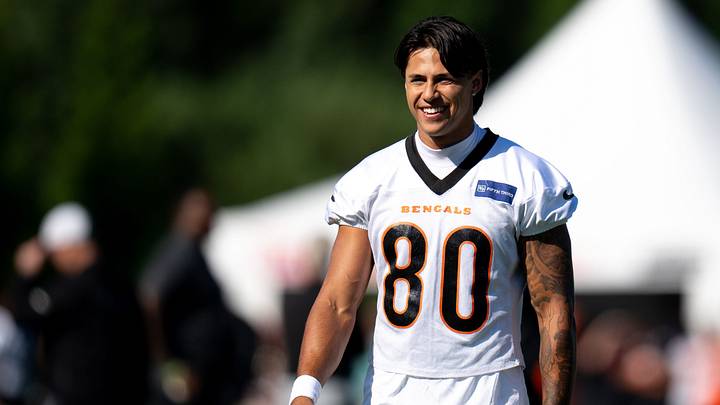
Andrei Iosivas entered Cincinnati Bengals training camp as the presumed third wide receiver behind Ja’Marr Chase and Tee Higgins. A few weeks later, rookie Colbie Young has made that assumption considerably less comfortable.
But Young may not actually be Iosivas’ biggest problem. At least, he isn’t the only one.
Cincinnati has built an offensive roster where Mike Gesicki can function as another primary receiving option, Charlie Jones provides special-teams value Iosivas doesn't, and Dohnte Meyers has enough receiving and return ability to make himself difficult to dismiss.
Suddenly, Iosivas isn't simply trying to hold off one rookie for WR3. He's trying to prove the Bengals still need what he specifically provides.
Colbie Young is making the obvious case against Andrei Iosivas
Iosivas wasn’t unproductive in 2025. He finished the year with 33 receptions and 435 yards and two touchdowns, so Cincinnati knows he can contribute between Chase and Higgins.
However, the Bengals didn’t burn a fourth-round pick on Young to simply watch him in practice. Young has size and developmental upside and has repeatedly flashed during camp. Which creates an obvious question:
If Young can give Cincinnati comparable WR3 production while developing into something more, how long does experience keep Iosivas ahead of him?
When you are making plays like this:
Colbie Young! 💪 pic.twitter.com/ccQRGmzdxo
— Faux Joey Brrr (@FauxJeaux) August 17, 2026
It’s hard not to stand out in practice.
Iosivas isn’t losing ground because he’s suddenly become a bad receiver. He may be losing ground because Cincinnati drafted someone with the potential to offer more.
Mike Gesicki has already changed what WR3 means in Cincinnati
Chase is the No. 1, we all know this. And while Higgins makes a No. 1 receiver on pretty much any other roster, he is a great No. 2 to have.
But does Cincinnati actually need a conventional wide receiver to be the third-most-important receiving option?
Maybe not.
Gesicki led Cincinnati’s tight ends with 307 receiving yards last season despite missing Weeks 7 through 11 with a pectoral injury. The Bengals also describe their TE room as deep and versatile entering 2026.
Cincinnati doesn’t need to force 80 targets toward whoever wins a traditional WR3 label if Gesicki can absorb many of the intermediate and matchup-based opportunities behind Chase and Higgins.
The question then goes from: Who is the third-best receiver?
To now: Who adds the most value with the opportunities that remain?
The Bengals’ third receiving option and their third wide receiver don’t necessarily have to be the same player.
Charlie Jones brings something Iosivas can’t easily replace
As Bengal fans, we all know the name, Charlie Jones. However, did you know that Jones didn’t record a single reception in 2025?
If that’s the case, how can he seriously make the WR3 conversation more interesting?
It’s because Charlie Jones’ primary job in 2025 wasn’t to be a receiver. He averaged 25.8 yards per kickoff return and returned the opening kickoff against Chicago for a touchdown, making his career total 3 touchdowns.
Iosivas is clearly a more accomplished NFL receiver than Jones. But roster decisions aren’t always made by ranking the position group from best receiver to worst receiver.
If Young takes offensive snaps that previously belonged to Iosivas while Jones holds a significant special-teams role, the math starts to get uncomfortable.
The thing to remember is that Jones isn’t necessarily beating Iosivas for a receiver spot; he is simply fighting for a place on the final 53-man roster.
Dohnte Meyers makes the Bengals’ decision even more complicated
Here is a guy who went from Presbyterian College to Delta State College, went undrafted, spent the 2024-2025 season in the CFL, winning the Grey Cup, and became the leading receiver in his preseason debut against the Lions.
This guy is dedicated; he shows up, even if it is to drive from Atlanta all night to be able to be in Cincinnati to throw with Joe Burrow.
He broke out in 2025 for the Saskatchewan Roughriders, with 65 catches for 1,056 yards and eight touchdowns. Not to mention 29.0 yards per kickoff return and 10.4 yards per punt return in his CFL career.
Looking here, it looks like he is keeping it rolling in Bengals camp:
Dohnte Meyers just keeps showing up pic.twitter.com/fdF5hiaF0r
— Jay Morrison (@ByJayMorrison) August 3, 2026
Meyers’ experience will give him multiple ways to be on the roster. If he can make plays as a receiver, stretch the field, contribute on returns, and play on coverage teams, he is going to be a hard guy to cut.
Young threatens Andrei’s offensive role. Jones threatens him with special-teams value. Meyers potentially threatens him with a little of both.
Moving on from Iosivas could accelerate Cincinnati’s younger receivers
Look, I love Iosivas, I really do, and honestly, it is surprising that this is where we are. But let’s take a serious look at what Cincinnati can gain by moving forward with him.
Potentially, Young will get more snaps. This would accelerate his development since he wouldn’t have to play behind another receiver.
Meyers would get more opportunities, and we would learn whether the CFL production would translate into the NFL.
Jones would have a clearer special-teams role because you aren’t occupying another WR roster slot with someone who doesn’t provide the same kicking-game value.
Add in Gesicki, and your offense doesn’t really lose a proven third receiving option.
Iosivas has 11 career red-zone touchdowns, which alone proves that there would be value they’d be giving up if this were the direction they decided to go.
The question isn’t whether Iosivas can help the Bengals. He already has. The question is whether Cincinnati now has players who could make better use of the roster spot and opportunities that he occupies.
Colbie Young remains the easiest name to attach to Iosivas’ training-camp competition because both are fighting for snaps at wide receiver. But Cincinnati’s decision is considerably more complicated than choosing between two players, which is a problem they haven’t had for a while.
Gesicki reduces the need for a traditional third receiving option. Jones brings proven value. Meyers offers upside with special-teams experience. And every snap given to Iosivas is one that can’t be used to accelerate Young’s development.
Andrei Iosivas isn’t just trying to beat Colbie Young. He’s trying to prove the Bengals still need him to fill a role that several other players may now be capable of filling.
 Add us as a preferred source on Google