

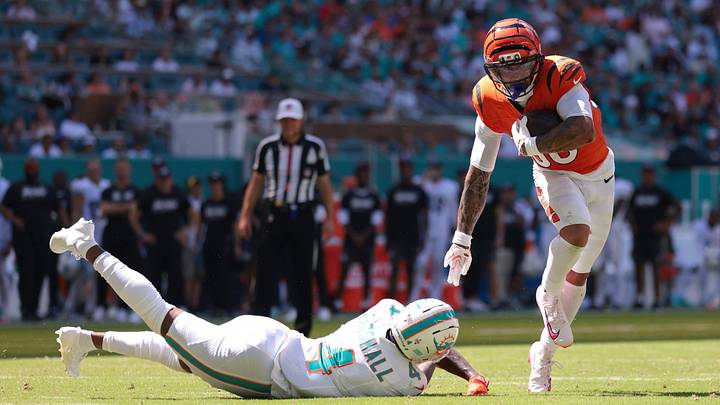
As we creep closer to the November 10th NFL trade deadline, the rumors are going to fly, Tesla Roadster style, about whom the Cincinnati Bengals should attempt to acquire.
One of the recent names ballied about is running back Jonathan Taylor, among others. That is because of Chase Brown’s recent fall from grace in the eyes of some Bengals fans.
However, before the Bengals trade for a running back, they should consider a few factors affecting how well Chase Brown and the Bengals are, or are not, rushing the ball before taking on a large salary at the running back position.
Chase Brown isn't the only one defenses have figured out
The Bengals have the fewest rushing attempts in the NFL, making them the league's most one-dimensional team. But it also makes it easier for defenses to recognize when and where Brown is getting the ball.
The result is that, despite the Bengals not running the ball a lot, to the delight of some, Chase Brown ranks 10th in the NFL in facing 8+ defenders in the box when rushing.
To reiterate, with Tee Higgins and Ja’Marr Chase at wide receiver, Brown has seen the 10th-highest percentage of heavy boxes when rushing among running backs with a minimum of 35 attempts.
Do you remember that catastrophic performance against the Jacksonville Jaguars when Brown rushed for ten yards on nine carries? Hard to forget, eh? It sparked the Bengals need-a-running-back talk.
But just in case, that was the same game when Cincinnati rushed 15 times for 23 yards as a team.
Brown's very first rushing attempt went for -5 yards on a play that Jaguars safety Antonio Johnson immediately shut down. Not a defensive lineman, linebacker, or edge rusher. It was a tackle for loss by a player who was at least the eighth man in the box.
It is almost as if the Jaguars knew what the Bengals would run before they ran it. Video suggests this was the case.
Anthony Campanile unleashed Antonio Johnson (6) in the Jaguars' Big Nickel package last weekend.
— Cody Alexander (@The_Coach_A) October 9, 2026
When the Bengals were in 12 personnel, Jacksonville used Johnson to attack the B-gap bubble with pressure.
Clip 1: Toss
Clip 2: Duo
Learn how other teams are attacking TEs, only… pic.twitter.com/MhlbH1ZDcz
Samaje Perine doesn't qualify just yet because Next Gen Stats sets the minimum cutoff at 35 carries. Perine has 27 attempts this season. Expect his workload to increase. But we will get to that later.
Despite being bad all of a sudden, Brown is the tenth-most efficient rusher according to Next Gen, higher than Jonathan Taylor.
Bengals' OL isn't doing Brown any favors
The offensive line also affects the effectiveness of the rushing attack, or lack thereof.
Despite having some impressive individual run-block win-rate percentages, according to ESPN, which ranks Cincinnati first in that category, PFF's grading for Cincinnati's offensive line's run blocking leaves something to be desired. A lot, actually.
The Bengals' best o-lineman, Amarius Mims, is the best pass blocker. He is the worst run blocker among the starting five and one of the worst in the league, according to PFF.
Mims ranks 71st out of 74 tackles in run blocking. Orlando Brown Jr. ranks 42nd.
Dalton Risner is by far Cincinnati's best run blocker, with an 80.7 run-block grade, which ranks ninth out of 77 guards. The front office should seriously consider re-signing him through the 2027 season.
Dylan Fairchild ranks 49th out of 77 guards in run blocking.
Ted Karras ranks 18th out of 35 centers. Still, his 61.9 grade is barely above OBJ's 60.5.
Perhaps three out of five offensive linemen just aren’t very good at run-blocking. Maybe the play-calling and scheme do not favor running the ball. They could even be self-sabotaging by abandoning the rushing attack when it is actually working.
When it comes to the stew that is the Bengals’ rushing attack, each of those is an ingredient.
Give Perine run, Zac Taylor time
The Bengals should stick with Chase Brown, considering everything that he brings to Cincinnati’s offense. However, the next-best option is to give their own running backs more carries before committing to a trade.
Samaje Perine has suddenly become Bengaldom's most popular player. It is a popular spot that is usually reserved for backup quarterbacks.
Nevertheless, Perine's 4.1 yards per carry is the lowest since he became a semi-permanent fixture in Cincinnati in 2020.
After Perine gets more carries, the Bengals may consider making a move for an RB ahead of the trade deadline if he performs better than Brown. However, if Perine performs at the same rate as Brown, the blame could fall on play calling, predictability, scheme, and run blockers.
Expect the rushing attack to look much improved after the bye week, no matter who the RB1 is. It usually takes Zac Taylor’s offense to figure out the offensive line and running game.
But before the front office and coaching staff consider a trade, the play calling needs to be less predictable, the scheme more suited to the opposing defense’s strengths and weaknesses, and three of the five offensive linemen need to improve their run blocking substantially.
 Add us as a preferred source on Google