

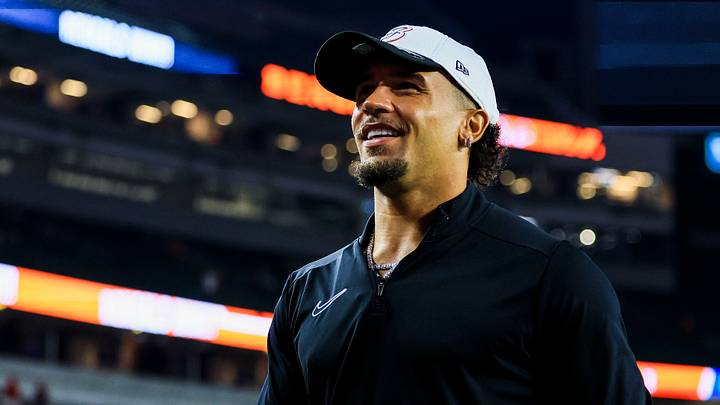
Arguing that the Cincinnati Bengals should give running back Chase Brown a contract extension has been a two-year-long campaign around here.
Still, as we imagine it must be for him and his agents, it has been incredibly frustrating for all of the on-field, fantasy, and ‘right thing to do after being so underpaid since entering the league’ arguments have gone for naught.
Now, thanks to Spotrac’s Michael Ginnitti, the front office has another persuasive argument that should help convince them to extend Brown sooner rather than later.
Brown could be crown jewel of 2027 FA
Ginnitti laid out the 49 running backs scheduled to be unrestricted free agents next offseason. Brown sits upon the Iron Throne of this group.
Of the running backs on Ginnitti’s list, only the Titans’ Tony Pollard rushed for more yards.
Brown was 11th in the NFL in all-purpose yards last season and led all on Ginnitti’s list in that category.
Furthermore, what Brown brings to a team as far as all-purpose yards, along with doing the dirty things like pass protection and blitz pickup, makes him arguably the best RB among next year’s free agent group.
Youth is also on Brown’s side, as Chase is the eighth-youngest among them. At 26.7 years old, Brown’s second contract will take him to 31 years old. At which point, his third contract risks looking a lot different, as teams are unlikely to give him another $14 million per year.
Being one of the youngest and most productive free-agent RBs will further increase his value if he is available to suitors next offseason.
Locking up a valuable and reliable piece for the offense with no better options currently on the horizon in next year’s market should be a priority for Cincinnati’s C-suite.
Replacing Brown with ‘cheap’ rookie isn't so simple
The Bengals could look to the 2027 NFL Draft for a replacement if free agency doesn't provide one. However, a few counterintuitive factors complicate that train of thought.
First, every team seems hesitant to rely on rookies as instrumental pieces to immediate success unless they need to.
Second, at running back in particular, pass blocking and blitz pickups become crucial in evaluating the position. That, contrary to what some would have you believe, was one of Brown’s strengths coming out of Illinois.
Furthermore, the Bengals could potentially spend just as much on a first-round rookie as they would on a veteran.
Jeremiyah Love is the 10th-highest-paid RB in the NFL despite never taking a professional snap.
Another issue with taking an RB early in next year’s draft is that it would be another match burned that should have been burned on a prolific offensive lineman, a capable future starting cornerback, or another position that has gone unaddressed because teams did not extend contracts that should have been extended.
Brown is already severely underpaid
Grinnitti’s list also shows just how badly Brown is underpaid among those unrestricted free agents scheduled to hit the market next offseason. This was further exacerbated by the plethora of extensions signed this offseason.
We can see Brown taking a contract that nets him $13 to $15 million per year, placing him in the top ten of RBs, where he belongs. He would quickly fall in the pecking order as new extensions spring up next year.
There is no world in which Brown should have a contract with the second-lowest annual value of his current contract on this list.
Furthermore, there is no way Brown should have the second-lowest annual value among running backs on the Bengals’ roster, ahead of Kendall Milton. Alas, here we are.
Brown also has a lower total contract value than Tahj Brooks. Again, there's no universe in which that should be the case.
Giving Brown a contract extension at this point seems like the right thing to do based solely on how underpaid he has been and continues to be.
And for the Bengals next offseason, given how the free agent market is shaping up, they probably will not have a shot at another RB as good as Brown if they are left to count on going that route.
 Add us as a preferred source on Google