

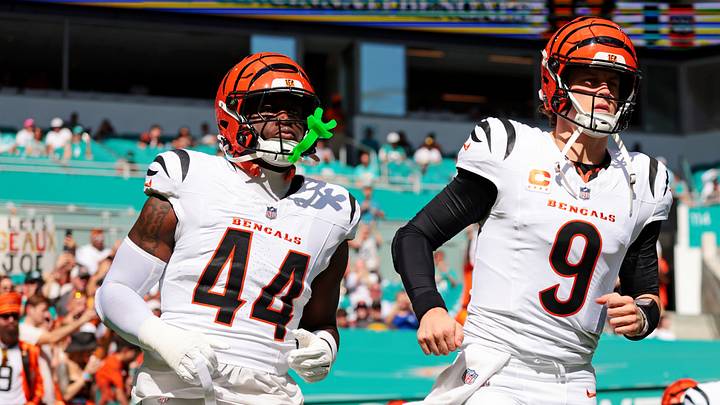
Joe Burrow, Ja’Marr Chase, and the Cincinnati Bengals' offense will most likely attract most of the attention this coming year. However, the Bengals will have to rely heavily on a defense improvement plan that will need to prove itself better than the 30th-ranked defense it was last year.
No player may be more important to that effort than second-year linebacker Demetrius Knight Jr.
The offense has never been in question, as the Bengals know who the stars are that can provide the output. The greater uncertainty lies on the defensive side of the ball. Cincinnati needs young defenders to develop into the foundational pieces needed to build a great defense.
Knight already gave Cincinnati something to build on
Cincinnati selected Knight in the second round of the 2025 Draft, 49th overall. The trade of Logan Wilson and the release of Germaine Pratt opened the door for Knight to play in all 17 games and become a starter for 14 of them.
During that time, the Bengals' official statistics show he racked up 106 tackles (55 solo), three sacks, seven passes defended, one forced fumble, and two interceptions, all of which came inside the Cincinnati red zone.
The coaching staff showed that they trusted him with a significant role as well, having him play in 73% of Cincinnati’s defensive snaps according to Pro Football Reference.
Those numbers do not describe a rookie who merely survived his first NFL season. They describe a player who quickly became one of the defense’s most active contributors.
Why Demetrius' second-year development is so critical
The Bengals don’t need someone who can simply take up space and get tackles. They need someone in the middle who can diagnose plays, communicate assignments, create pressure as a blitzer, and fix a major problem that plagued the defense last year, which is preventing short gains from being explosive plays.
When you have strong linebacker play, they can cover mistakes both in front of and behind them, which can help a defensive line against the run, protect defensive backs underneath, and force offenses into more obvious passing situations.
Currently, Knight is listed with Barrett Carter, another second-year linebacker, making both of their development all the more important to Cincinnati’s defensive plans.
There's a difference between production and impact
Knight has shown that he has no problem accumulating tackles; the next step is making more of those tackles consequential.
We all know that not all tackles are created equal. Tackling a receiver after an 8-yard gain is different than stopping a run for 1 yard or forcing a quarterback to check the ball down.
His rookie numbers showed versatility, especially with three sacks, seven pass breakups, and two interceptions. The challenge is turning those flashes into week-to-week consistency.
Cincinnati doesn’t need Knight to chase 150 tackles. They need more of his tackles to end possessions.
How a Knight breakout changes the entire defense
Let’s assume that Knight has a breakout season, and take a look at how that has a ripple effect throughout the defense.
- Against the run: Faster recognition will help close the interior gaps, better tackling will help Cincinnati stay out of second-and-short situations, not to mention anytime your linebackers are playing well, it allows your defensive line to pin their ears back and get after the opposing QB.
- In pass coverage: The AFC North has become a place that will test defenses with a mobile QB in Baltimore, an experienced QB in Pittsburgh, and while Cleveland is still a wild card, either of their QBs can be a threat on a run or scramble. That being said, Knight’s two interceptions and seven pass defenses show that he is no slouch in the passing game. If he shows improvement here, it could easily reduce completions over the middle.
- As a blitzer: Knight accumulated three sacks last year, showing that he has the ability to get after the quarterback. He could be used creatively to help alleviate the pressure off the edge rushers. Anytime you have well-timed linebacker pressure, that can make your entire defensive front difficult to predict.
- Leadership and communication: Having a dependable middle-of-the-field linebacker can help align not only the defensive front, but the secondary as well. This will come in handy, considering how many young players they will be featuring.
Best- and worse-case scenarios for Knight
For Knight to have a successful second year, it doesn’t need to be a statistical explosion or anything record-breaking (although it would be nice). He just needs to become more efficient against the run, more consistent in coverage, and more disruptive near the line of scrimmage. The Bengals could have a substantially better year defensively without his totals changing much from last year.
If Knight remains merely productive rather than becoming a consistent, impactful player, Cincinnati may still find itself asking Burrow and the offense to compensate for the defensive shortcomings.
Cincinnati would remain vulnerable over the middle and continue to struggle to get off the field on third down. It would cause more pressure to be applied to the young defensive backs behind him. Finally, yet again, the offense would be forced to win high-scoring back-and-forth games.
The player who connects everything
We all know that Burrow will determine the Bengals ceiling, and Chase will remain to be one of, if not the league’s most dangerous weapon. But we already expect that, we have already seen that. Cincinnati’s season may be changed by the players who provide more consistency than was not present a year ago.
Demetrius Knight Jr. showed during his rookie season that he belongs on Cincinnati’s defense. His second season will reveal whether or not he is a player who can become a leader and a voice on that side of the ball. If that development occurs, the Bengals may finally have the kind of presence over the middle that will make everyone around him better.
If Cincinnati’s defense becomes the reason that the Bengals go on a championship run, rather than being the obstacle in their way, Knight could be the player at the center of the transformation.
 Add us as a preferred source on Google