

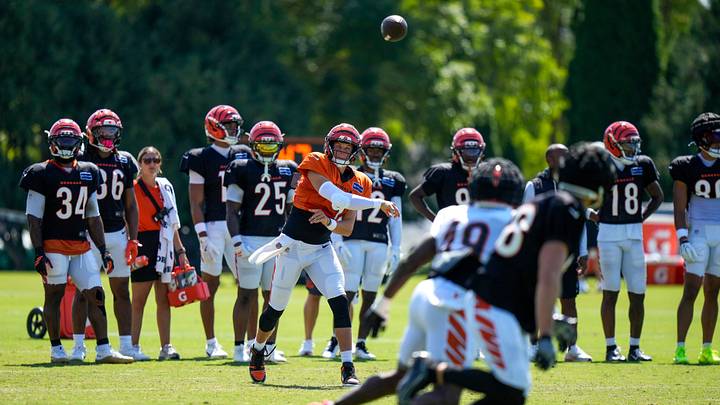
Something feels different with this year's Cincinnati Bengals.
The fans definitely feel it. Unlike the past few years, there's been a definite change in how fans perceive the team. Before, there was an overwhelming sense of dread before the start of the season. Yes, the team COULD be good, but there seemed to be just too many factors in the way of their success.
This time around, there's more optimism. Everyone's more excited to see this new-look Bengals team take the field. The defense got miles better. Joe Burrow remained healthy throughout training camp. Any injuries incurred in training camp proved to be short-term. Everyone's excited for this season to start.
Burrow's comments about this year's Bengals should make fans even more amped up. Speaking to reporters, the star quarterback compared this year's team to his old 2019 LSU team. Burrow said that that old team felt "inevitable", a feeling that he once again has this year, via Sports Illustrated's Albert Breer:
"I don’t know, it just felt inevitable. We finished stronger the year before… I just knew how things felt around the building. I knew how practices were going. I knew that offense fit my skill set more so than any one I had been in. It just made sense to me."
It's not a crazy statement to make: here's why Burrow's "feeling" is more than just a mere hunch.
A deadly receiving corps
First, let's look at Cincinnati's receiving core. The 2019 LSU team was built primarily on the strength of their receiving group. The Bengals have done everything they can to give Burrow a similar supporting cast to what he had in LSU, and they've done an excellent job.
Ja'Marr Chase's best comparison is...Ja'Marr Chase. Chase was the top wide receiver for that LSU team in 2019, and the same holds true for this year's Bengals. He is everything a quarterback and offensive coordinator wants from a wide receiver: he's fast, gets open on his routes, secure hands, and is a threat at all areas of the field. That one is easy.
Naturally, Tee Higgins slots into the Justin Jefferson role for the Bengals. Higgins is a good three inches taller than Jefferson, and he doesn't quite run routes with the same technicality that Jettas does. However, he's the Bengals' best threat on the outside, and his catch radius and sticky hands reminds us of Jefferson's reliability in LSU as a deep/outside threat.
Joe Burrow loves himself a good pass-catching tight end, and he has that this year in Mike Gesicki. Gesicki functions a lot like Thaddeus Moss in the Bengals' offense: he's not the primary option, but he is a reliable pass-catcher on the back end of plays or as a checkdown option. Both Gesicki and Moss aren't exactly the best athletes for their position, but they are reliable options for a pass-heavy scheme like Cincinnati's and LSU's.
A tale of two pass-catching backs
The one stark difference between 2019 LSU and the current Bengals, at least for now, is their willingness to run the football. Despite being the most dangerous passing team in the nation, Burrow's Tigers ran the football 44.8% of the time. That's a massive difference from last year's Cincinnati team: they ran the ball at the second-lowest rate at 36.05%.
Perhaps Burrow's comments about the inevitability stems from the Bengals' renewed efforts in the run game. While the Bengals did not run the ball often, they were pretty effective when they did. That's thanks in large part to Chase Brown's efforts: he finished the season with over 1,000 rushing yards and 1,456 all-purpose yards, showing his versatility in the backfield.
Brown is a lot like the Tigers' running back in that regard. Clyde Edwards-Helaire was LSU's best running back at the time, finishing with 1,414 yards and 16 touchdowns just on the ground alone. Both Brown and Edwards-Helaire excel by breaking ankles with their quick-twitch movements instead of running downhill, and they're also excellent out of the backfield as a pass-catching option.
A defense full of playmakers
The one-to-one comparison kind of falls apart on defense, though there are still some interesting parallels to fall back on. The most apt one-to-one comparison is on the secondary: LSU's defense was anchored by two of the best defensive backs in the nation at that time.
Much like standout cornerback Derek Stingley Jr., DJ Turner II is the Bengals' best lockdown corner and is one of the best players at his position.
Although the two players differ in how they shut down opposing wide receivers, the results are the same: an incomplete pass thrown their way or the quarterback not even looking in their vicinity. While Stingley is in firm contention as the best cornerback in the league today, Turner isn't far behind him in the rankings.
At the safety position, the Bengals have Bryan Cook to mirror LSU's Grant Delpit. Both players are underrated safeties who are elite Swiss Army knife defenders capable of doing anything a defense wants them to do. They're willing players in the run game and are also excellent in coverage, with Cook finishing sixth in pass coverage per PFF and Delpit recording an 18.2% incompletion rate in his final year in LSU.
Past the secondary, the comparison starts to become a bit wonkier. LSU had a solid interior defensive line with Tyler Shelvin and Neil Farrell, but neither player quite compared to the wrecking ball that is Dexter Lawrence for the Bengals.
The closest comparison to pass rusher K'Lavon Chaisson for Cincinnati might be Boye Mafe, but Mafe is a much more complete player and has been more productive in the NFL. And of course, the Bengals don't have a Patrick Queen at the linebacker position, though they're certainly hoping that Demetrius Knight Jr. blossoms into that role.
The linchpin behind the machine
And finally, we get to the man of the hour. Burrow was the driving force behind both 2019 LSU's rampage throughout the nation and the Bengals' two-year campaign in 2021 and 2022. Since that time, though, Burrow has only gotten better, and it's thanks to his attention to detail.
One of the only weaknesses of Burrow coming out of LSU was his ability to throw outside the numbers to his receivers. His deep ball accuracy coming out of college was shaky, and there were questions about whether he could throw the ball on deep go routes. Burrow was never on Tua arm strength levels, but there were still questions.
Now, his accuracy on deep balls (and accuracy in general) has only gotten better. With Chase and Higgins by his side, Burrow has become more confident throwing the ball to the outside. There are many plays where Burrow finds either receiver on a go route and delivering the ball perfectly in time and in rhythm. He's also great at finding chunk plays now and delivering the ball through tight windows to his receivers.
His awareness in the pocket has improved, his sack evasion has been much better, and he's also shown more willingness to throw away the ball instead of fighting for his life in the pocket when things go awry downfield. He's gotten better at the little things that he struggled at in previous seasons, while still keeping what makes him such a deadly quarterback: calm processing in the pocket, elite accuracy and vision, and an aggressiveness rarely seen in today's quarterbacks.
Burrow isn't the same player that led LSU to an undefeated championship in 2019. Nor is he the same quarterback who led the Bengals to two deep playoff runs and a Super Bowl appearance earlier in the decade.
He's even better. And now, he's ready to take the Bengals to the promised land and finish what he started in 2021.
 Add us as a preferred source on Google