

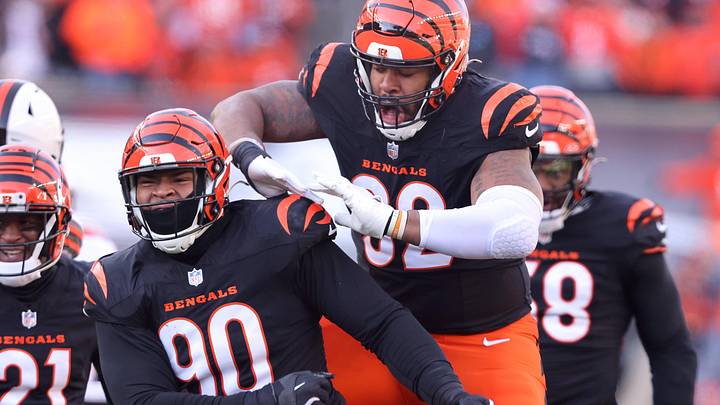
The Cincinnati Bengals are up against the salary cap, a situation the front office is unaccustomed to navigating. As a result, things could get interesting in the next few days.
The Bengals, and the rest of the league, are coming up on June 1st, one of the more important dates of the NFL offseason.
June 1 is the date by which the cost of releasing players may change, allowing teams to move on from players or spread out the cap penalties over multiple seasons in the event of a trade.
Post June 1differs from salary cap cut candidates, as we will only look at the largest delta between the pre- and post-June 1 implications. As dead cap penalties and cap savings change, the fulcrum shifts, altering how players, agents, and teams perceive the June 1 date.
With that, here are three players who were with the Bengals last season who should be wary of the June 1 date now that the Cincinnati Bengals are near the bottom of the league and salary cap space, a position in which they are very unfamiliar.
BJ Hill’s cap situation changes dramatically after June 1
Defensive tackle BJ Hill was one of the first to rejoice in the Bengals’ trading with the New York Giants for Dexter Lawrence ahead of the NFL draft.
His joy is understandable, as Hill now gets to play with one of the very few defensive tackles whom opposing teams double-team more than the Bengals’ defensive tackle did last season.
Currently, the Bengals would incur a $7.3 million dead cap hit if they released Hill, while saving only $4.8 million against the salary cap, ultimately costing the team $2.55 million.
On the other side of June 1, however, releasing Hill would cost the Bengals $3.6 million in dead cap money while saving $8.45 million, resulting in savings of $4.85 million.
The pre- and post-June 1 designation gap for Hill is $7.4 million. For reference, that total would be enough to compensate for either Trey Hendrickson's $5.6 million cap hit or Logan Wilson's $4 million one for the upcoming season.
Between Trey Hendrickson, Logan Wilson, and Jermaine Burton, the Bengals have a dead money charge of $10.4 million heading into the 2026 season.
We do not expect Cincinnati to move off of Hill's contract. But the delta between his dead cap hit and salary, cap savings if released, is the greatest among all players who were on the roster last year.
Nevertheless, we expect Hill to play out this season next to Lawrence, his former Giants teammate.
Joe Burrow’s trusted weapon has a notable June 1 wrinkle
Another player we won't expect the Bengals to part ways with this season is tight end Mike Gesicki.
Quarterback Joe Burrow fought hard for the Bengals to bring him back last season and is an integral part of the team’s passing offense.
With that, the difference between Gesicki’s pre- and post-June 1 figures is vast.
Pre-June 1, the Bengals would incur a $4.3 penalty while only saving $3,250,979 against the cap, resulting in a -$1,082,355 difference. Post June 1, his cap penalty decreases to $2.16 million, while the savings would shoot to $5,417,647, with $3,250,981 in cap relief.
Gesicki’s delta of $4.3 million is the second most on this list. But again, he is 99.9% guaranteed his roster spot with the Bengals this upcoming season.
That includes Jack Endries making good on his promise to make all the teams that passed on them in the draft regret it, and a fully healed Erick All Jr. ready to go.
June 1 lowers cost of moving on from Kris Jenkins Jr.
Another defensive tackle who should be keenly interested in the June 1 date is Kris Jenkins Jr. However, in this case, it is a matter of costing the Bengals less if they were to move on rather than any potential salary cap savings.
The Bengals drafted Jenkins with the 49th overall pick of the 2024 draft. However, his development, or lack thereof, is a significant reason why the Bengals should overhaul their defensive line this offseason, and one of several top 100 draft picks along the defensive line over the past few seasons that have not worked out as well as we had hoped.
Jenkins dead cap penalty falls from $2,264,678 to $1.6 million after June 1. Furthermore, the Bengals will have to pay an additional $120,915 to release him before June 1, with no salary cap relief, whereas the team would save $513,260 afterwards.
The cost of releasing Jenkins after June 1 rather than before is a dead cap penalty difference of $1,147,435.
No, the Bengals would not be saving money against the cap by parting ways with their former second-round draft pick. However, if they were having any consternation about doing so after acquiring two highly paid defensive tackles this offseason, it will cost them a lot less to do so post June 1.
The Bengals could also attempt to trade the former second-round draft pick to a team that is looking for defensive line help with upside while on a rookie contract.
Cincinnati would have been that team before this past offseason.
Other Bengals cap casualties still loom
There are several candidates for salary cuts on the roster. One of the names that comes up in those discussions is TJ Slaton. Another whom you may hear increasingly about in that particular category is safety Jordan Battle.
But the players for whom June 1 changes their situations the most significantly are BJ Hill, Kris Jenkins, and Mike Gesicki.
Expect Hill and Gesicki to be with the Bengals this upcoming season. As for Jenkins, the cap savings are not there, but if his performance isn’t, neither will he be.
With the Bengals ranked 30th in cap space, with $7,173,064 available, we may see something unexpected, including decisions made based on the salary cap implications that come after June 1.
 Add us as a preferred source on Google