

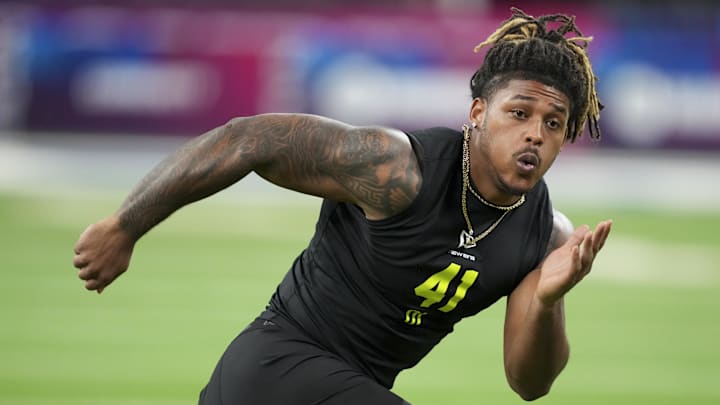
The Cincinnati Bengals had multiple safer routes to choose with their first pick in the 2026 NFL Draft at No. 41 overall, but they went big-game hunting with Texas A&M pass rusher Cashius Howell.
We have drafted DE Cashius Howell with the no. 41 overall pick. pic.twitter.com/bL2i5GLRHg
— Cincinnati Bengals (@Bengals) April 24, 2026
After drafting Shemar Stewart with last year's 17th pick from that same Aggies program, the Bengals are back to the well of College Station for a far different sort of outlier at the same position.
In Howell's defense, his sack production at A&M dwarfs that of the much larger-framed Stewart. He had 11.5 sacks in 2025 alone; Stewart had 4.5 sacks in three years for the Aggies. However, this selection reeks of high risk and high reward. Dangerous territory for a Bengals defensive unit that needs immediate-impact players.
Cashius Howell is a bold risk the Bengals didn't need to take...will it pay off?
The whole pre-draft narrative around Miami (Florida) defensive end Rueben Bain Jr. about his short arm length caused him to fall all the way to the Bucs at the 15th pick. If not for those lesser limbs, Bain would've gone much higher and earned millions of dollars more.
Here's the thing about Cashius Howell: His arms are even shorter than Bain's. And he's 10 pounds lighter.
But my goodness, can Howell bend with the best of them and absolutely explode in off the edge. Hence this mixed evaluation from FanSided expert Marcus Mosher, who believes Howell has a Nik Bonitto-esque ceiling but also a pretty low floor:
"Howell's short arms and small frame will limit him at the next level, but he was born to be a pass rusher. He's got elite bend and a variety of pass-rush moves in his tool box. His best fit will be in a 3-4 defense where he can line up wide and use his speed to get to the quarterback, but he's better against the run than you would think for a 252-pound EDGE rusher. Howell should have an immediate impact as a pass rusher and could have a Nik Bonitto like role in the NFL."
Any notion of a 4-3 or 3-4 base alignment on defense is a bit of a misnomer, but if anything, the Bengals' personnel is more suited to four down linemen. What's good about Howell is he has enough athleticism in space to play as a linebacker, as defensive coordinator Al Golden alluded to after the pick was announced:
Al Golden said Cashius Howell can be a 4-2 edge, an outside backer on five down fronts, can drop when you need to. He's a multi faceted athlete who's really, really twitched up.
— Charlie Goldsmith (@CharlieG__) April 24, 2026
So at least there's a plan there. I'd have preferred to see the Bengals address their glaring hole at linebacker with someone like Texas Tech star Jacob Rodriguez, but at the very least, Howell should bring value as a designated pass rusher in his rookie campaign.
Quite a stacked defensive line Cincinnati is building this offseason. Dexter Lawrence was the big splash in exchange for the 10th overall pick, but Boye Mafe and Jonathan Allen all add pass rushing juice, which Howell brings in spades himself.
What's really interesting is Howell's preexisting relationship with Stewart. How will that go in Cincinnati? Will competition bring out the best in Shemar, or will their roles be different enough in Golden's scheme to where they can both contribute?
It's objectively hilarious what the Bengals did here with this Stewart-Howell combo in back-to-back drafts. From an all-time size-athleticism freak show, to get another elite athlete who's a historical outlier in a key metric that often makes or breaks NFL success.
The Bengals went against every narrative we give them about EDGE rushers.
— Gridiron Grading (@GridironGrading) April 24, 2026
Cashius Howell is a historically small, older EDGE with an ELITE analytical profile.
This is a bet on production over traits.
He knows how to win as a rusher but the size and age is the risk. pic.twitter.com/ENKCN28ojb
May the football gods be with us, Who Dey Nation. Sounds like we need a miracle for Howell's best outcome to come true if his 30 1/4" arms are any indication — and historically, they are.
 Add us as a preferred source on Google