

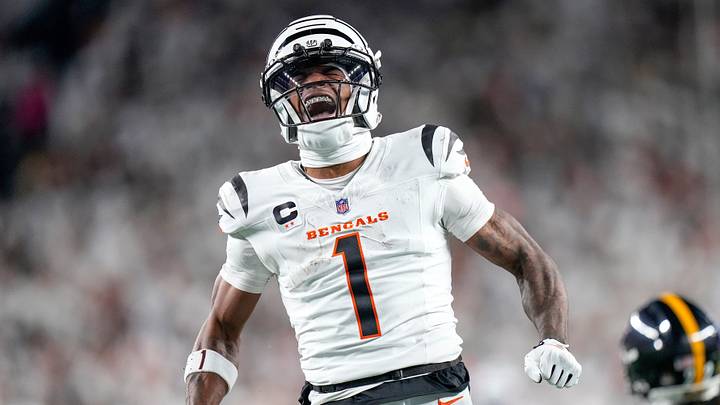
We all knew that the Cincinnati Bengals' offense was great. We saw glimpses of their excellence last season, and 2024 gave us a prolonged taste of what we thought a full-power Bengals' offense would look like. Cincinnati's unbreakable core of Joe Burrow, Ja'Marr Chase, and Tee Higgins always had the potential to be the greatest in the league.
Yet, we're seeing a level of production that's truly unprecedented from this unit. The Bengals have been the best offense in the league this season, and they're doing it in a completely different way than traditional elite offenses. Let's take a deep dive into the analytics and see what allows the Bengals to break the mold and be an offensive force even without the usual characteristics of a juggernaut.
The (offensive) Standard is the Standard

Run the football. It's an age-old adage in in the sport, yet it still holds true today. Even with the rise of complicated passing schemes and quarterbacks who can sling the ball 50 yards with ease, a good run game remains the foundation of many elite offenses in the modern NFL.
Just take a look at the 2024 Detroit Lions, who had one of the best rushing attacks to complement their play-action pass scheme. Or the 2025 Seattle Seahawks, who ran the ball relentlessly despite the apparent inefficiency. Most good offenses either have a healthy mix of run and pass plays, an efficient run game, or both.
Yet, the Bengals have neither of those qualities. The Bengals rank dead-last this year in run-play percentage, running the ball just 35.3% of the time. They also don't get a lot of yardage every time they run, averaging just under 3.9 yards per carry. All that talk about reviving the run game and running the ball more went out the window as soon as the season started.
A good run game allows the offense to move the chains calmly with less risk. A passing play is inherently a much more turnover-prone play. By running the ball efficiently, you're able to "stay on schedule" and not force too many "risky" plays. You're able to generate short-yardage situations constantly that are relatively easy to convert.
The Bengals are thriving in spite of the lack of a run game. Why is that? Let's look at the key stats explaining Cincinnati's offensive brilliance and compare them to the rest of their competition. We'll be looking at the top five teams this season in points scored per game, which are the San Francisco 49ers, the Bengals, the Jacksonville Jaguars, the Buffalo Bills, and the Dallas Cowboys.
Part 1: What's a third down?

A third down is the most nerve-wracking moment in any offensive drive. Every time the Bengals get themselves into a third down, I clench a little and hope for the best. A failed third-down attempt usually means the said team is either punting or settling for a field goal. It's a do-or-die scenario that's often bad news for teams.
The Bengals have found the cure for managing this third-down nervousness: they just don't get there at all. The Bengals this season have the second-fewest third downs with just 104, or 11.5 third downs per game. In comparison, the 49ers have 100 in nine games; the Bills have 105; the Jaguars have 111; and the Cowboys have 133 in 10 games.
What's important to note here is the Bengals operate differently on first and second down compared to their peers. Cincinnati, unsurprisingly, leads the league in pass play percentage on first down. However, they are "successful," or gain more than 40% of the yardage needed, a whopping 66% of the time. The 49ers are nearly just as successful on their first-down pass attempts, but they also attempt a pass play on just about 50% of their first-down attempts.
That's just a ridiculous stat. It's a similar story on second down: the Bengals are second in pass-attempt percentage on 2nd-and-short and medium, and yet they are successful (in this case, gaining yards 60% or more) 59% of the time.
Part 2: Keeping it moving

Of course, the Bengals aren't immune to third downs. Occasionally, Joe Burrow misfires, or Chase Brown runs into a brick wall. Cincinnati then finds themselves in third down, a high-pressure moment for most teams.
The Bengals aren't most teams. Even when they do get to third down, the Bengals are just simply better than nearly every team in the league. They rank second in the league in third-down conversion rate at a whopping 51.9%. The third-ranked team in this metric, the Bills, sit at 46.8%. That's almost the gap between the Bills and the Chiefs, the 10th-ranked team.
What I want you to look at, in particular, are two things. First is their third-down success in short-yardage situations (1-3 yards away). The Bengals, as always, prefer to pass in this scenario (56.4% of the time). However, when they do decide to run the ball, they have been ridiculously effective. They're able to get the line to gain 14 out of 17 times.
Some of these are quarterback sneaks, yes, but most of them are designed runs for Samaje Perine to just use his power to get to the marker. The Bengals can run the ball when they need to.
The other stat worth noting is their efficiency in third-and-long situations (7+ yards). If we exclude runs on third-and-longs (which, let's be honest, isn't really an attempt to get the line to gain), the Bengals are far and away the most efficient team. They convert on their third-and-long pass attempts a whopping 46.9% of the time. The 49ers, who are just below them, sit at 42.9%.
This is, truly, the stat that holds this Bengals' offense together. When your third-and-long is generally a manageable distance for your offense, life just becomes much easier.
Part 3: A different kind of explosive

Another common indicator of a good offense is how often they generate explosive plays. By this metric, the Bengals are a pedestrian offense. They are 15th in the league in this statistic, per Sharp Football Analysis. The Bills (7.7%), 49ers (7.2%), and Jaguars (6.8%) all rank significantly higher than the Bengals in this metric.
Diving into these explosive plays, it's clear the Bengals' lack of a run game hurts them severely. They're slightly below average in that regard (18th, with 9.8% of their run plays going for 10 or more). They're also just slighty above average in generating explosive pass plays (pass plays that go for 20+ yards), with 9.4% of their 340 pass attempts being explosive plays, 13th in the league.
What makes the Bengals offense hum, then? Well, even though Cincinnati doesn't generate traditional "explosive plays", they are still great at generating chunk plays. They are second in the league in plays that go for 10+ yards (23.9% of their plays go for more than 10 yards).
This makes it really easy for the Bengals to stay in rhythm and control the time of possession, even if they're not running the ball often. They are ninth in time of possession in the league, despite being the most pass-heavy offense.
Part 4: The Ja'Marr's and Joe's (and Tee's) behind X's and O's

Why does this offense work? It's simple: because it's the Bengals.
Let's start with the man leading the way... and his crew of bodyguards. Joe Burrow is easily the best pocket passer in the league. Blessed with preternatural pre-snap and post-snap processing and perfect accuracy, Burrow is the conductor who leads this team to success. His ability to find the open man and deliver a strike each time is what makes this offense tick.
Now, Burrow is armed with perhaps the best offensive line he's seen in his NFL career. Two or three seconds is all he needs to process the field, and the Bengals' offensive line is giving him more than that. Add to that his pocket movement and scrambling ability, and you have yourself the MVP of the 2026 season.
It helps when you have two elite wide receivers. Both Ja'Marr Chase and Tee Higgins are elite weapons that Burrow isn't afraid to target, especially on money downs. Most of Burrow's completions on third down are to his two best wide receivers, and for good reason. They get open, and on the off chance they don't get enough separation, Burrow's passes find their mitts anyway.
Out of the 104 third downs the Bengals had this year, Burrow targeted Chase 19 times. He answered the call 13 times. Burrow took a shot at Higgins 19 times as well during third-down scenarios. He also delivered 13 times.
The chemistry between these three players is simply off the charts. This trio is why this team is breaking the norm and why they're set to become one of the most dominant offenses in modern history.
 Add us as a preferred source on Google