

There is legit fear that many of the popular targets for the Cincinnati Bengals at 10th overall in the NFL draft will be gone by the time the team is on the clock.
If that turns out to be the case, there is a lot of scuttlebutt, and quite frankly, fear, that the Bengals could select Auburn defensive end Keldrick Faulk with their first pick as Duke Tobin prioritizes traits over production.
However, there is another option later in the first round that offers similar physical characteristics while providing more productivity than Faulk and last year's first-round pick, Shemar Stewart. And, the front office could add to Cincinnati’s draft haul in the process.
Duke Tobin’s draft philosophy isn’t changing
There is significant concern that the Bengals will continue to prioritize traits over production in the 2026 NFL draft. And fans should be worried because the de facto GM, Duke Tobin, has zero intention of changing his draft philosophy.
A more cynical way to translate this is that the front office would rather select players who look like they could fit a role than those who have already shown they can play the part.
However, as the French would say, there is more than one way to draft a cat, which will leave the team and fans with their cake and eating it too.
Missouri edge rusher is the compromise Duke Tobin didn’t know he needed
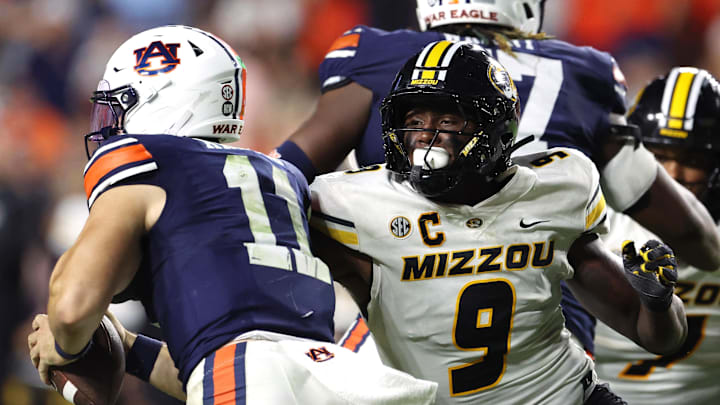
While no one is talking about him to the Bengals, Missouri edge rusher Zion Young fits the physical traits the organization covets and offers more college production than Stewart and Faulk.
At the combine, Young measured in at 6’6, 262 pounds, with 33-inch arms. His arm length is well above Ruben Bain’s 30 7/8 inches but falls short of the longest arm length measured at the combine, Keldrick Faulk’s 34 3/8.
Nevertheless, Young's physical attributes should satisfy the requirements set forth by Tobin’s strict philosophy. But we will have to wait until Missouri's pro day to get his final testing numbers.
Proof that traits and production can coexist
Meanwhile, while Young's college production is not on a par with Texas Tech's David Bailey, for example, he was more productive than Stewart and Faulk.
Last season, Faulk recorded 29 tackles, five tackles for loss, two sacks, and four passes defended.
In his final season at Texas A&M, Stewart had 31 tackles, 5.5 tackles for loss, 1.5 sacks, two passes defended, and one forced fumble. Those numbers are nightmarishly similar to how Faulk performed this past season.
Meanwhile, Young recorded 42 tackles, 16.5 tackles for loss, 6.5 sacks, two passes defended, and two forced fumbles last year for Mizzou.
Further driving home the point, in Stewart’s 37 games, he recorded 65 tackles, 11 tackles for a loss, and 4.5 sacks. In 38 games over his final three collegiate seasons, Young finished with 110 tackles, 26.5 tackles for loss, and 10.5 sacks.
Young was also second among all pass rushers this year in pressure percentage.
Pressure Rate for Notable Edge Prospects
— The GOAT House (@GoatHouseNFL) February 25, 2026
David Bailey 22.9%
Zion Young 18.7%
Romello Height 17.6%
Malachi Lawrence 16.8%
Rueben Bain 15.7%
R Mason Thomas 13.6%
Cashius Howell 13.1%
Akheem Mesidor 12.8%
TJ Parker 12%
Keldrick Faulk 10.1% pic.twitter.com/9Ng2tnKwQv
Not only did Young show off his ability to cause havoc and rush the passer, but he also led all edge defenders in run stop rate.
Notable 2026 EDGE prospects' run stop rate in their final season (avg of 1st round picks since 2015 is 7.7%)
— Jack Brentnall (@Jack_Brentnall) February 18, 2026
Zion Young - 9.3%
David Bailey - 9%
Keldric Faulk - 8.6%
TJ Parker - 7.6%
Rueben Bain - 6.9%
R Mason Thomas - 6.2%
Akheem Mesidor - 5.5%
Malachi Lawrence - 4.2%
Cashius…
Stewart’s and Young’s play style is eerily similar to each other. Furthermore, how their respective teams deployed them on defense in college is almost identical, as each of them lined up everywhere along the defensive line.
However, Stewart excelled neither at rushing the passer nor at run-stopping. Far from it.
Going thru my Shemar Stewart notes this morning and one thing of note:
— Fran Duffy (@FDuffyNFL) March 20, 2025
His lack of production is NOT just a pass game issue
Just 21 career 'Run Stops' on 575 run defense snaps = a run stop rate of 3.7%
That would rank 203rd out of 204 charted EDGEs drafted in last decade
All of this is to say that Zion Young is who the Bengals were hoping to get when they selected Stewart with the 17th overall pick in last year's draft.
A trade-back scenario that makes too much sense
When it comes to the total amount of draft picks, the Bengals are well behind their AFC North division rivals.
However, one way to close the gap would be to trade back a few spots from the 10th pick and acquire a couple of Day 2 or 3 picks from a team looking to move into the top 10.
Moving back would allow Cincinnati to target another defensive end similar to Shemar Stewart, but with significantly more production.
Pro Football Focus has Young going 31st to the New England Patriots in their post-combine mock draft. If you are a loyal follower of PFF, you could see the Bengals trading several spots down in the first round and picking up a more productive Shemar Stewart-type player while re-cooping draft picks along the way.
However, if this is a viable plan for the front office, they should not move back too far, as we should expect Young to gain steam ahead of the draft, if it hasn’t begun already.
NFL Draft Analyst @LanceZierlein has the Panthers drafting Missouri edge, Zion Young, in his latest mock 2.0. pic.twitter.com/16H0iST9bt
— Two Growls One Roar (@2growls1roar) March 3, 2026
Keldric Faulk comparisons to Shemar Stewart not fair, but…
We should note that it isn't fair to compare Faulk to Stewart based solely on their college statistics. They have similar production concerns, but they are not the same player.
Nevertheless, the concerns are not without merit. Furthermore, it is clear that Faulk, like Stewart, would be better off as either a defensive tackle or a middle linebacker, as he does not offer much as an edge rusher, at least not in his 2025 season.
However, his collegiate totals are much closer to Young's than to Stewart's. Nevertheless, whatever the Bengals saw in Stewart, they will certainly see more of it in Young, not Faulk.
Furthermore, whereas Faulk took a step back in his last year, Young showed he is only getting better, and his best is yet to come.
We can’t quite put our fingers on, or heads around, why or how Young is behind Faulk on draft boards. Even Mel Kiper Jr. has Young two spots behind Faulk, while recently noting that Young could go off the board before Ruben Bain and Akheem Mesidor.
The Bengals may not have to select Zion Young with the 10th overall pick, or at all. However, it is incumbent upon the front office to know that there is another way to draft narratives and traits, with more college production while picking up extra draft picks in the process.
Either way, Cincinnati must have a plan beyond counting on Stewart to develop into something no one has ever seen from him in college or the pros at this point. Why not let that plan begin with a player similar to, but more productive than, last year’s first-rounder?
 Add us as a preferred source on Google